Cabo San Lucas or San José del Cabo: Where to Stay, and What It Costs You Either Way
Updated September 26, 2026 · 8 min read

“Los Cabos” is not a town. It is a municipality with two very different centres at either end of it: Cabo San Lucas at the tip, San José del Cabo about 32 km to the east, and a strip of resort coast called the Corredor Turístico in between. The drive between the two takes 25 to 35 minutes when the road is behaving.
Almost every booking site treats them as one place. They are not, and the difference shows up on your third morning, when you have worked out that the thing you want to do is at the other end.
The number that decides more than atmosphere does
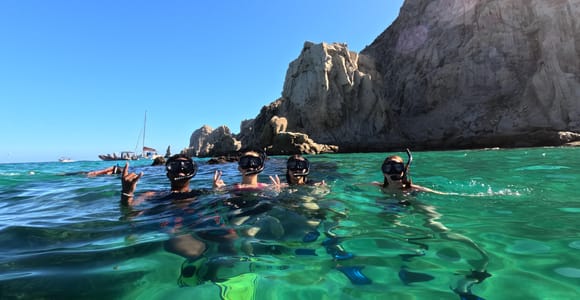
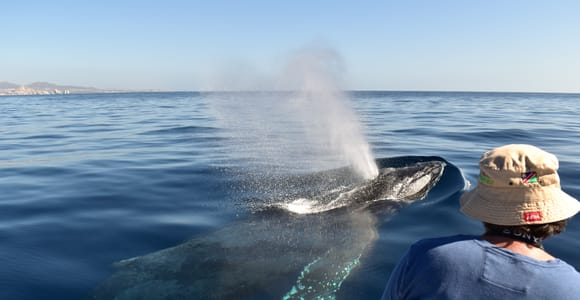
Across our Los Cabos listings, 195 of the 240 activities give Cabo San Lucas as their departure point, and 13 give San José del Cabo. That is not a quirk of the listings. The marina at Cabo San Lucas is where the boats are – the whale trips, the snorkelling catamarans, the sunset cruises, the glass-bottom boats out to El Arco.
If your holiday is built around being on the water, staying in San José del Cabo means a taxi or a bus at the start and end of most days. That is not a reason to avoid it. It is a cost, in money and in an hour of your day, and it should be in the decision rather than discovered afterwards.
What each town actually is
Cabo San Lucas is the busy one: the marina, the nightlife, the restaurants that are open late, and Playa El Médano, the long town beach on the bay. Médano is also the one beach in either town where swimming is normally straightforward, which matters more than it sounds.
San José del Cabo is the older, quieter one – a colonial centre around a church and a plaza, a gallery district, and hotels spread along a beach that is a good deal less forgiving than Médano. It runs on a different clock. There is very little happening after ten in the evening, and if one person in your group wants a late night, they are looking at a 30-minute drive each way.
The beach question is not symmetrical
This is where a lot of people get it wrong, because a beach that looks idyllic and a beach you can swim from are two different things here.
Cabo San Lucas has Médano. San José’s hotel strip faces open water, and when a long swell arrives, the municipality’s beach service flies red flags along the corridor beaches at San José – that has included Acapulquito, Santa María, Palmilla and Las Viudas in the same notice. The certified, calm-water bays – Palmilla, Chileno, Santa María – are all in the corridor, between the towns, not in either of them.
The detail matters enough to have its own page: which beaches in Los Cabos you can actually swim from goes through the flag system and what the certification does and does not promise.
Getting between them, honestly
The bus. The Ruta del Desierto public bus runs the highway between San José del Cabo and Cabo San Lucas for about MX$37, roughly every 8 to 10 minutes, from around 4:30 a.m. until about 11 at night. It is air-conditioned and it is what people who live here use. It stops near La Comer in San José and near the Puerto Paraíso mall in Cabo San Lucas – so it connects the two centres, not your hotel door.
A taxi between the towns costs many times that, and the price is agreed before you get in rather than metered.
Your own car. Here is the point where the question becomes real rather than theoretical: if you are staying in the corridor, or in San José and planning to be in Cabo San Lucas most days, you are either paying for a lot of taxis or you are driving. The road between them is a straightforward four-lane highway, and the beaches worth reaching – the certified bays – have no bus stop. It is worth comparing car hire for Los Cabos against a week of transfers before you decide. Read the excess and the deposit terms before the headline price, because that is where two quotes that look identical stop being identical.
And the honest counterweight: if you are staying in Cabo San Lucas, walking to the marina every morning and coming back by boat, a car will sit in a hotel car park for a week.
The airport points the other way
Los Cabos International (SJD) is next to San José del Cabo, not next to Cabo San Lucas. Staying in San José buys you the shortest transfer of your trip at both ends; staying in Cabo San Lucas costs you the longest one, twice.
For one week that is a small thing. For a long weekend it is a real slice of the holiday, and it is the single strongest argument for San José that has nothing to do with taste. What the arrival itself involves – including the sales floor between customs and the exit – is covered in getting from SJD airport to your hotel.
The corridor: a compromise with a condition
Staying in the Corredor Turístico puts you roughly equidistant from both towns and directly at the calm bays. The condition attached is simple and often skipped over: out there you are dependent on wheels for everything, including dinner. Resorts along the corridor are largely self-contained by design. If the plan is to wander out and find somewhere to eat, that plan needs a car or a taxi every single evening.
One fixed reason to be in San José on a Thursday
The Art Walk in San José del Cabo’s Gallery District runs every Thursday evening from 5 to 9 p.m., from November to the end of June. The galleries behind the church open late, around Calle Álvaro Obregón and the cobbled streets near the plaza, usually with music and street stalls.
It is free to walk, it is the one evening when the quiet town is the lively one, and it is the strongest single argument for putting a Thursday in San José even if you are sleeping at the other end. Outside the November-to-June season it does not happen at all, which is worth checking against your dates rather than assuming.
So which one
Cabo San Lucas if you are here mainly for boats, if you want to walk to dinner and to the marina, if the group includes people with different bedtimes, or if you want a town beach you can swim at.
San José del Cabo if you are here for a short trip and want the short transfer, if you would rather have a plaza than a marina, if you are travelling in the Art Walk season, or if what you want from the evening is dinner and quiet.
The corridor if the beach itself is the holiday and you have already decided about the car.
Whichever you pick, the day trips run from both – La Paz, Balandra and Todos Santos has pickups at either end, and the rest are on the day trips from Los Cabos page. If you want to see both towns in one go without solving the transport problem yourself, there is a six-hour city tour of San José del Cabo and Cabo San Lucas at €76.54, 4.9 stars from 22 reviews.