Swimming in Los Cabos: Which Beaches You Can Get Into, and Which Ones Fly Red Flags
Updated September 26, 2026 · 8 min read
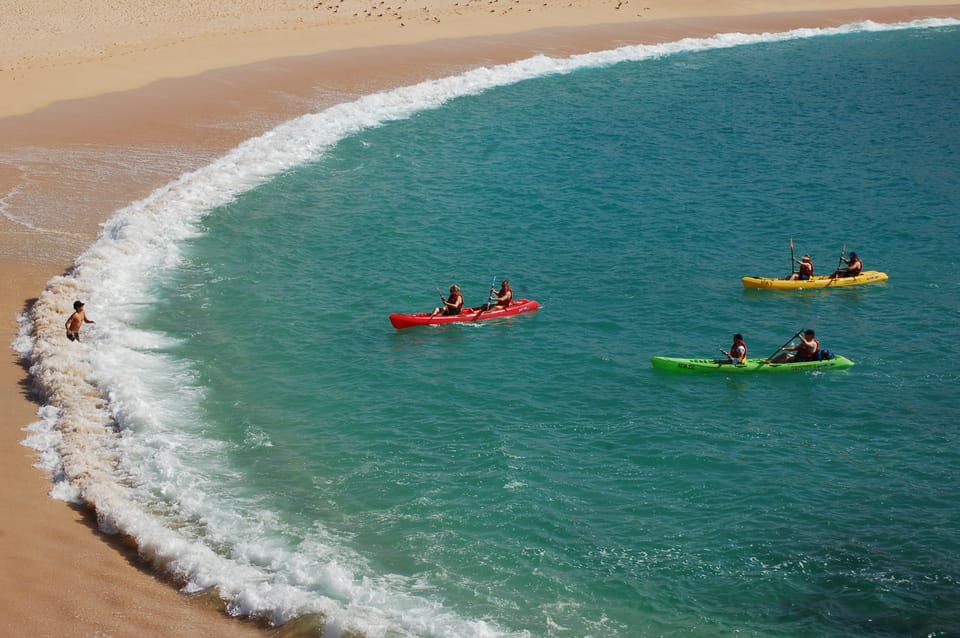
Los Cabos sits on a corner. On one side is the Sea of Cortez, on the other the open Pacific, and the peninsula stops between them at Land’s End. That corner is the reason the beaches here are not interchangeable: two stretches of sand twenty minutes apart can be a family swimming beach and a place nobody should enter the water.
The good news is that you do not have to judge it yourself. There is a flag flying, and it is updated as conditions change. The bad news is what most visitors assume the flags mean.
The flags, and what each one actually says
The municipal beach service uses a colour system on the monitored beaches:
- Green – condiciones óptimas para nadar: good conditions for swimming.
- Yellow – peligro moderado: moderate danger, entry permitted with caution.
- Red – the beach is very dangerous. Not “be careful”. Stay out.
- Black – prohibido meterse al agua: entry to the water is prohibited outright, along with recreational activity on that stretch of shore.
- White – jellyfish, known locally as agua mala.
Trained lifeguard staff are kept at the high-traffic beaches – Palmilla, El Chileno, El Médano and Migriño among them – and the flags are changed as the sea changes. Follow what the staff tell you; they are watching the water you are about to swim in, and this page is not.
The thing nobody tells you about the blue flags
Los Cabos is the national leader in Blue Flag certifications. Palmilla and Santa María hold the “A+” distinction – the only two beaches in Mexico that do – and El Chileno was the first here to be certified. Sections of Playa El Médano, plus Las Viudas, are on the list too.
Now the part that matters. When a long swell ran up the coast, the beach service posted red flags at Acapulquito, Santa María, Palmilla and Las Viudas, and at the corridor beaches at San José del Cabo. On another occasion Playa El Médano itself was closed under a black flag because of high surf.
Those are the same names. Blue Flag certification is about water quality, facilities, environmental management and safety provision – it is not a statement about the sea on the day you arrive. A certified beach with a red flag is still a red flag. If you take one thing from this page, that is it.
The municipal flag reports put the corridor’s reality more bluntly than any brochure will: when a swell runs, Las Viudas, Santa María, El Chileno and the rest of the corridor beaches go under red and black flags together, as a block.
Where swimming is normally straightforward
The tourism board names Médano Beach in Cabo San Lucas and Lovers Beach near El Arco as suitable for swimming, and describes Playa Acapulquito and Chileno Beach as generally placid and calm.
In practice the three bays people mean when they say “we want to swim” are:
Playa El Médano – the long town beach on the Cabo San Lucas bay, and the only walkable swimming beach in either town. It is protected by the headland, it has the shallowest entry, and it is busy.
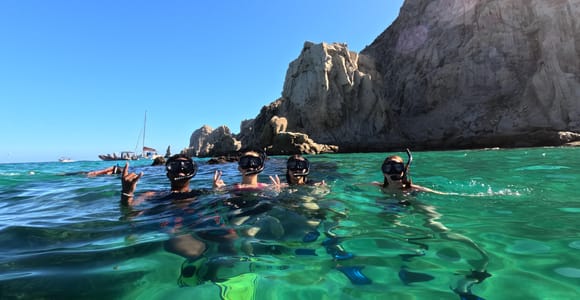
Playa Chileno – a sheltered cove in the corridor with a reef, the first Blue Flag beach here, and the one most day trips use for snorkelling.
Playa Santa María – a curved bay whose shape absorbs much of the swell. One of the two A+ beaches.
All three have one thing in common that their photographs do not show: they are in the corridor or on the bay, on the Sea of Cortez side.
Where you should not get in, on any day
The Pacific side is a different sea. Divorce Beach – the seaward half of the sand spit at Land’s End – and Playa Solmar below the Pacific-facing hotels are photogenic and they are not swimming beaches. The water shelves away steeply a few metres out, the waves break directly onto the sand with no reef or bay to take the energy out of them, and the currents run hard.
There is a visible clue, once you know to look for it: the Pacific-facing resorts are the ones built around large pools. That is not a design preference.
The sand spit at Land’s End makes the contrast unusually plain, because the two beaches are back to back. Playa del Amor faces the Sea of Cortez and people swim there; walk a hundred metres across to the Pacific side and you are somewhere else entirely. El Arco and Playa del Amor covers how you get out there and back.
Mar de fondo: the danger that arrives on a beautiful day
The swell events that close these beaches are called mar de fondo – long-period groundswell generated by weather far out to sea. The reason it catches people is that it does not look like weather. The sky is clear, there is no wind, and the sea appears calm between sets.
That is exactly when the beach service posts red and black flags on beaches that were green the day before. If you arrive at an empty beach on a perfect morning and there is a red flag, the emptiness and the flag are the same piece of information.
What this means for the way you plan
If swimming from a beach is the point of the holiday, stay on the Sea of Cortez side and take the corridor bays into account when you choose a base – they are between the towns, not in them. Cabo San Lucas or San José del Cabo goes through what that does to your transport.
If you are travelling with children, Médano’s shallow entry and the sheltered shape of Chileno are the reason those two names come up again and again. Los Cabos with kids has the rest.
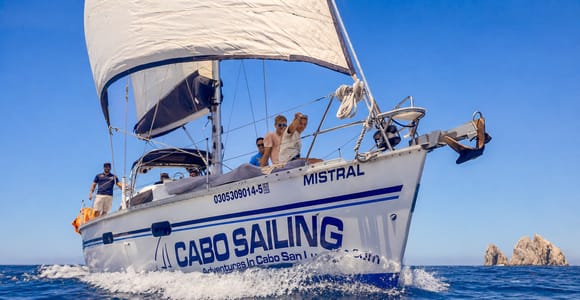
If the water is the reason you came, going out by boat sidesteps most of this, because the operator decides whether conditions allow the swim stop and will move or cancel it. A kayaking and snorkelling trip to Santa María and Chileno reaches both bays in three and a half hours – €86.88, 4.9 stars from 69 reviews – and snorkelling at Santa María and Chileno covers what you see down there. That trip states no children under 7 and a 125 kg weight limit, which rules it out for some of the families this page is written for.
There is also a boat ride to El Arco and Playa del Amor with swimming time at €22.91, three hours with two of them on the beach, 4 stars from 21 reviews – the cheapest way to swim at Playa del Amor rather than look at it from a boat.
Three habits worth having here
- Look for the flag before you look for a spot on the sand. On monitored beaches it is there, and it is current.
- Ask the lifeguard. They will tell you where the entry is safest on that beach at that hour, which no website can.
- Do not use yesterday’s flag, or a photograph, or this page, as today’s answer. The sea here changes over hours.
The full range of what is on the water – 69 snorkelling trips from €9.93, and the water sports – is on the snorkelling in Los Cabos and water sports pages.