Whale Watching in Los Cabos: the Season Has Legal Dates, Not Approximate Ones
Updated September 26, 2026 · 7 min read
Most destinations describe their whale season with a shrug: winter, roughly, ask when you get there. Mexico does not. The dates are set by the environment ministry, published in the federal gazette before each season, and they differ from one stretch of coast to the next.
For the waters off Los Cabos, the season runs 15 December to 30 April. Outside those dates there is no legal whale watching here, and no operator will take you looking – not because the whales have all left on 1 May, but because the permission to approach them has expired.
That single fact decides more trips than anything else on this page. If your flights land in November, this article is about a different holiday than the one you booked.
Which whales, and where the other ones are
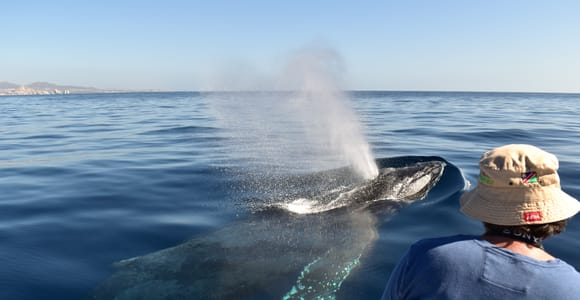
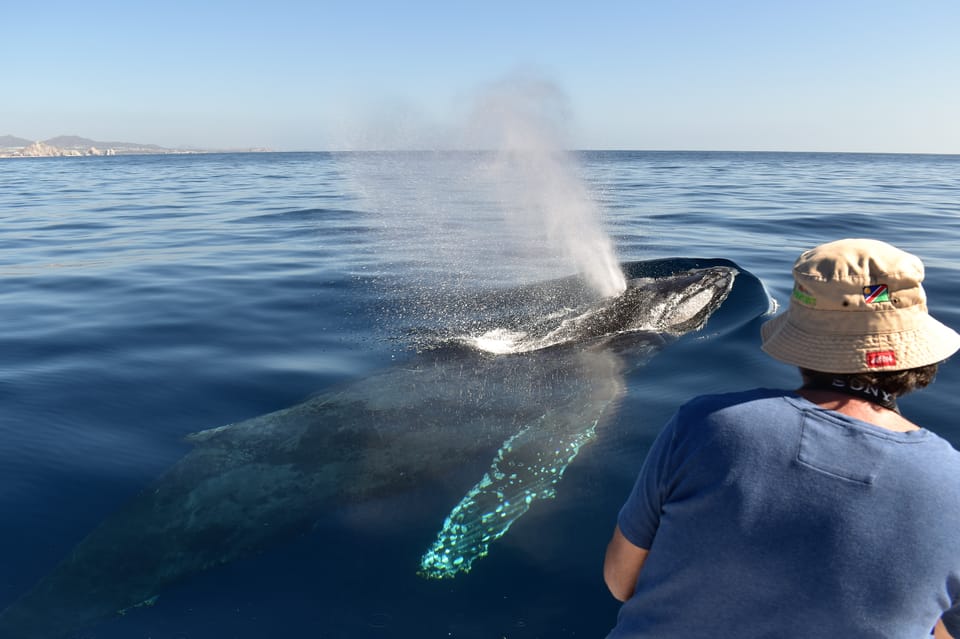
What you come here for are humpbacks. They winter in the warm water at the tip of the peninsula, they breed and calve here, and they are the species the Los Cabos boats are built around – close inshore, often within sight of the hotels.
Grey whales are a different animal in a different place. They fill the shallow lagoons on the Pacific side of Baja California Sur, and those areas have their own dates in the same notice. Laguna Ojo de Liebre and Laguna San Ignacio, in the Vizcaíno reserve, open on 15 December – the same day as Los Cabos. The Magdalena Bay region and Bahía Almejas open later, on 1 January. All of them close on 30 April. It is a long drive north, it is a different kind of day – flat water, small boats, whales that come to you – and it is not something you fit in around an afternoon at the pool. If somebody sold you Los Cabos as a grey whale trip, they sold you the wrong coast. The Bahía de Loreto national park shares that 1 January date, but it lies on the Sea of Cortez side and its draw is blue whales, not greys.
Why the boat stops further away than you expected
Whale watching in Mexico runs under a national standard, NOM-131-SEMARNAT-2010, and it is more specific than most visitors realise. The waiting distance is 240 metres for every vessel, whatever its size – that is how far off a boat holds when it is queuing behind another. The actual observation distance depends on the size of the boat and the species being watched, and the standard says it should preferably be measured with a rangefinder rather than estimated.
So when a captain cuts the engine and sits there while the whale is still a long way off, that is the rule working, not a bad driver. The corollary is worth knowing before you spend money: bring or borrow binoculars, and pick a boat where you will be able to hear what you are looking at.
The trip that does the most with those limits
If you are going to be held at a distance anyway, the thing that changes the experience is sound. A whale watching boat trip with an all-women crew and photos puts a hydrophone in the water so you hear the humpback song directly, carries a marine biologist on board, and includes the digital photos – two hours, €83.40, 4.9 stars from 318 reviews. It picks up from hotels and meets in front of La Terminal de Cabo.
It is not suitable for children under five, for pregnant women, or for people with back problems. That is the operator’s own list, and the reason for it is the boat: small, fast and slamming into chop for two hours.
Two alternatives with real track records. Whale watching with transport and pictures included runs two and a half hours at €75.96, 4.9 stars from 195 people. And the whale watching catamaran is two hours at €86.20, 4.7 from 131 – a bigger, steadier platform, which is the right trade if somebody in your group is worried about the sea rather than about getting close.
What “guaranteed sightings” actually promises
Several operators here advertise guaranteed sightings, and the all-women trip spells out what it means: if no whales are found, you go again for free. Not a refund – a second trip.
That is a fair offer and a common one, but it only helps if you have a second morning. Book your whale trip for the first half of your stay, not the last day. People who leave it to the final morning and see nothing have bought a voucher they cannot use.
When in the season to come
Within the legal window, sightings are not evenly spread, and nobody can honestly promise you a week. What we can say is what our own inventory shows: on the most-booked whale trip here, the recent reviews cluster in February, March and April. Early in the window – the second half of December – the season is open but only just.
Mornings are the better half of the day, for the ordinary reason that the wind gets up later. And if there is any doubt about seasickness, the calmest water and the shortest slam are both in the morning too.
What to do if you are here in the wrong six months
Say this plainly, because it is the question the season dates create. From May to early December there is no whale watching in Los Cabos, and the boats that do it in winter are doing something else: 28 sunset cruises from €34.75, 69 snorkelling trips from €9.93, 38 catamaran and sailing trips from €35.12.
The one that comes closest to the same feeling is a boat ride that goes out to the headland and the sea lion colony instead of looking for whales – that is a year-round animal, and it is covered in El Arco and Playa del Amor.
If you are booking now for the coming winter
The season dates are published each autumn in the federal gazette for the season that follows; the notice for 2025–26 appeared on 10 October 2025 and set 15 December to 30 April for the Cabo San Lucas area. The pattern has held for years, so planning around those dates is reasonable – but if your trip sits right on the edge, in the second week of December or the first days of May, check the current notice rather than this page.
All twenty-six whale trips, from €34.75, are on the whale watching in Los Cabos page.